Tunbridge Wells Church and Cemetery Desecrations
Lords of ChaosThe Tunbridge Wells Church and Cemetery Desecrations were a series of attacks carried out in 1994 by members of Necropolis, an underground Black Metal group in Kent, England. The incidents moved from broken and overturned headstones to vandalism inside churches, and culminated in arrests and prison sentences. The group’s campaign brought the Norwegian Black Metal scene’s anti-Christian rhetoric into a local setting, where criminal acts won the youths more attention than their music did.
Background and Influences
By spring 1994, British newspapers and music magazines had extensively covered church burnings in Scandinavia. Kerrang! had repeatedly presented the Norwegian scene through accounts of shocking acts and statements by figures including Varg Vikernes. A small group of teenagers in Tunbridge Wells took particular notice of Vikernes’s claim that church arson was a form of heathen terrorism. Their actions followed this coverage, although the evidence describes the group’s inspiration and emulation rather than establishing that any one article directly caused a particular attack.
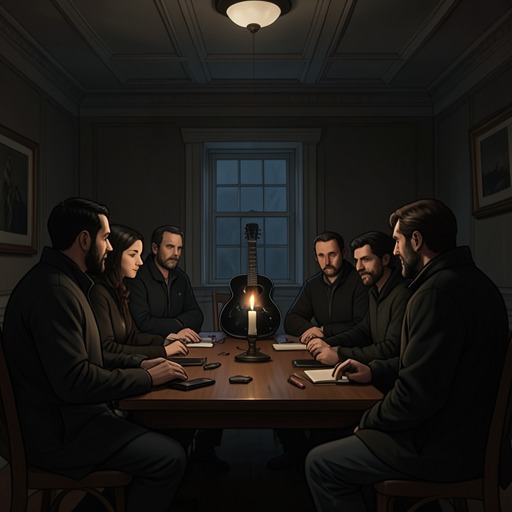
The group of friends, led by 18-year-old Paul Timms, formed the nucleus of Necropolis. Its other members were Dave Wharton, a 22-year-old postman; Mark Reeves, also 22; and Kevin Mooney, a 21-year-old British Airways engineer. Timms’s girlfriend later said that the band had been formed under Norwegian influence. Coverage of the case suggested that attacking churches was a way for the youths to gain respect and notoriety from the musicians they admired. Necropolis does not appear to have recorded any music, making the contrast between its musical identity and its criminal activity especially stark: the attacks, rather than recordings, became the group’s public signature.
Course of the Attacks
The campaign began in April 1994 with damage to graveyards in Rusthall and Tunbridge Wells. In a single night, the group could knock over or break as many as sixty headstones. The scale and repetition turned isolated acts of vandalism into a sustained assault on local burial places, affecting not only the sites themselves but the communities connected to them.
Over Easter, the attacks widened to St. Peter’s Church in Southborough and St. Mark’s Church in Tunbridge Wells. At St. Mark’s, windows were shattered, the altar was damaged, prayer books were torn up, and church objects were overturned. Timms later said that the group wished it had burned the church afterward; he also claimed that they would have targeted larger churches if they had access to explosives. Those remarks indicate that destruction by fire was part of the group’s imagined escalation, but the documented attacks described here were desecrations and vandalism, not church arsons.
The group returned about a week later to attack the church in Southborough and St. Peter’s Church in Fordcombe. Its final assault involved graveyards in Speldhurst, Groombridge, and Frant. Cross-shaped headstones were among those pulled up and left upside down. The repeated reversal of the crosses made the attacks legible as anti-Christian provocation as well as property damage, while the targeting of cemeteries extended that provocation to the dead and their relatives.
Stated Motives and Public Meaning
Timms described the group as Satanists and framed its actions as revenge against Christians, arguing that Christians had displaced pagan boundaries and built churches over them. His explanation echoed the heathen and anti-Christian language associated in British coverage with Varg Vikernes. The evidence thus records both a practical campaign of vandalism and an ideological account offered by one of its participants; it does not establish that all members held identical beliefs or that the claimed religious rationale exhausts their motives.
The attacks also show how a musical subculture’s public image could travel beyond music. Reports about Norwegian church burnings and the rhetoric surrounding Black Metal gave the Tunbridge Wells group a model of notoriety, while the local crimes made that borrowed image concrete. Yet the resulting publicity did not establish Necropolis as a musical act: the group apparently recorded nothing, and its renown rested on attacks against churches and cemeteries. In this case, the distinction between adopting a style and carrying its rhetoric into criminal conduct became difficult to separate in the public story of the group.
Arrests and Sentences
Police arrested members of Necropolis in simultaneous raids on May 27, 1994, after receiving an anonymous tip. The first arrests were Wharton, Reeves, and Mooney; officers had not initially realized that Timms was connected to the group. A homemade Necropolis poster found during the searches of their homes depicted its four members and helped investigators recognize that another suspected participant might still be at large. Timms was arrested two days later. The account suggests that the tip may have followed someone overhearing him discuss the crimes with his girlfriend in a pub, but presents that as a possibility, not a confirmed source.
The youths expected community service, but received sentences of two and a half years in prison. During a court hearing before a Catholic judge, Timms wore a Cradle of Filth T-shirt bearing an anti-Christian slogan. When prison staff asked what he wanted to eat, he requested a Bible, then refused food for four days before giving up the protest. The damage was assessed at a minimum of £100,000, or $160,000, and might have been substantially higher. The sentence, the scale of the losses, and the group’s failure to establish itself through music closed the campaign with a consequence sharply at odds with its pursuit of underground status: its notoriety became inseparable from the harm and cost of the desecrations.